
Leggera Technologies
Thixomolding vs. Magnesium Die Casting: Porosity, Wall Thickness, Tool Life and Cost
The 60-Second Answer
Short answer: both processes make near-net-shape parts from the same magnesium alloys. Magnesium die casting injects fully molten metal and is faster per shot. Thixomolding injects a semi-solid slurry at a lower temperature, which gives lower porosity, thinner walls and longer mold life, with fewer steps after molding. Die casting is usually the better call for small, simple, very-high-volume parts; thixomolding wins on thin-wall structural parts, housings and large parts where a feature die casting cannot give, or fewer steps after molding, pays for itself.
We are a thixomolder, so we have a side in this. That is why every public figure below names its source and date, our own figures are credited to us, and the section on when die casting is the right call is written as plainly as the rest.
Key takeaways
- Die casting is faster per shot and usually cheaper per piece.
- Thixomolding gives lower porosity, thinner walls and longer mold life, with fewer steps after molding.
- The same magnesium alloys run in both, so the choice is about the part, not the material.
Jump to the comparison table · Download the two-page comparison sheet (PDF)
Eight Factors, Side by Side
Thixomolding vs. Magnesium Die Casting: Eight Factors
| Factor | Thixomolding | Magnesium die casting |
|---|---|---|
| Melt state | Semi-solid slurry. Chips are heated to 560° to 600° C (Leggera thixomolding page, 2026), inside AM60B’s 540° to 615° C melting range (International Magnesium Association, accessed October 2026). A machine maker gives 590° to 610° C (Japan Steel Works, a thixomolding machine maker, accessed October 2026). | Fully molten metal. Typical molding temperatures run 630° to 650° C hot chamber and 680° to 700° C cold chamber (Japan Steel Works, a thixomolding machine maker, accessed October 2026). |
| Porosity | Under 1.5% (Huang, Jiang and Wang, Journal of Magnesium and Alloys, 2025). 50% lower than die cast (Leggera homepage, 2026). | 1.5% to 4% in one hot-chamber AM60 study (Rzychoń and Kiełbus, Materials, December 2024). Porosity from entrapped gas is the process’s “biggest drawback” (Luo, Journal of Magnesium and Alloys, 2013). |
| Minimum wall | 0.020 in. (0.5 mm) (Leggera thixomolding page, 2026). 0.5 to 0.6 mm (Huang, Jiang and Wang, Journal of Magnesium and Alloys, 2025). | 1 to 1.5 mm for magnesium (Luo, Journal of Magnesium and Alloys, 2013). |
| Tool life | Mold life rated 1, against 0.9 for hot chamber and 0.8 for cold chamber (Huang, Jiang and Wang, Journal of Magnesium and Alloys, 2025). Molds can last 1,000,000 shots (Leggera homepage, 2026). | 250,000 to 300,000 shots for a typical magnesium die (Luo, Journal of Magnesium and Alloys, 2013). |
| Yield and scrap | No slag (Huang, Jiang and Wang, Journal of Magnesium and Alloys, 2025) and no dross or sludge (Japan Steel Works, a thixomolding machine maker, accessed October 2026). | About 40% to 60% of the metal becomes process scrap via the runner system and overflow (International Magnesium Association, accessed October 2026); die casters can reprocess virtually 100% of it, at an energy cost (North American Die Casting Association (NADCA), Product Design for Die Casting, 2015). |
| Part size limits | Set by the machine. Our two new 2,500-ton machines will let us mold parts as large as a cross car beam (Leggera, 2026). Machines of 3,000 to 4,000 tons have been launched (Huang, Jiang and Wang, Journal of Magnesium and Alloys, 2025). | Large castings are in serial production, such as a die-cast AM60 cross beam over 170 cm long (International Magnesium Association, accessed October 2026). |
| Alloys | AZ91D, AM60B, AM50A (Huang, Jiang and Wang, Journal of Magnesium and Alloys, 2025). Leggera publishes AM60B data (Leggera capabilities page, 2026). | The same alloys: AZ91D, AM50 and AM60 (NADCA, Product Design for Die Casting, 2015). |
| Typical cost drivers | Chip feedstock costs more than ingot (NADCA, Product Design for Die Casting, 2015); cycles run about 1.2 to 1.25 times longer (Huang, Jiang and Wang, Journal of Magnesium and Alloys, 2025); fewer steps after molding (Leggera process comparison, 2026). | Energy to melt the alloy and to remelt runner and overflow scrap, which typically adds 5% to 10% to material cost (NADCA, Product Design for Die Casting, 2015); cover gas (Luo, Journal of Magnesium and Alloys, 2013); X-ray, straightening and more machining (Leggera process comparison, 2026). |
Cells credited to Leggera are figures Leggera Technologies publishes on leggeratech.com, or states for this guide (Leggera, 2026). Every other figure is quoted from the public source named in the cell. Studies use different alloys, parts and machines, so treat ranges as typical, not guaranteed for your part.
Download the comparison sheet. The same table plus a part-envelope diagram, on two pages for your design review. Get the PDF.
How Thixomolding Works
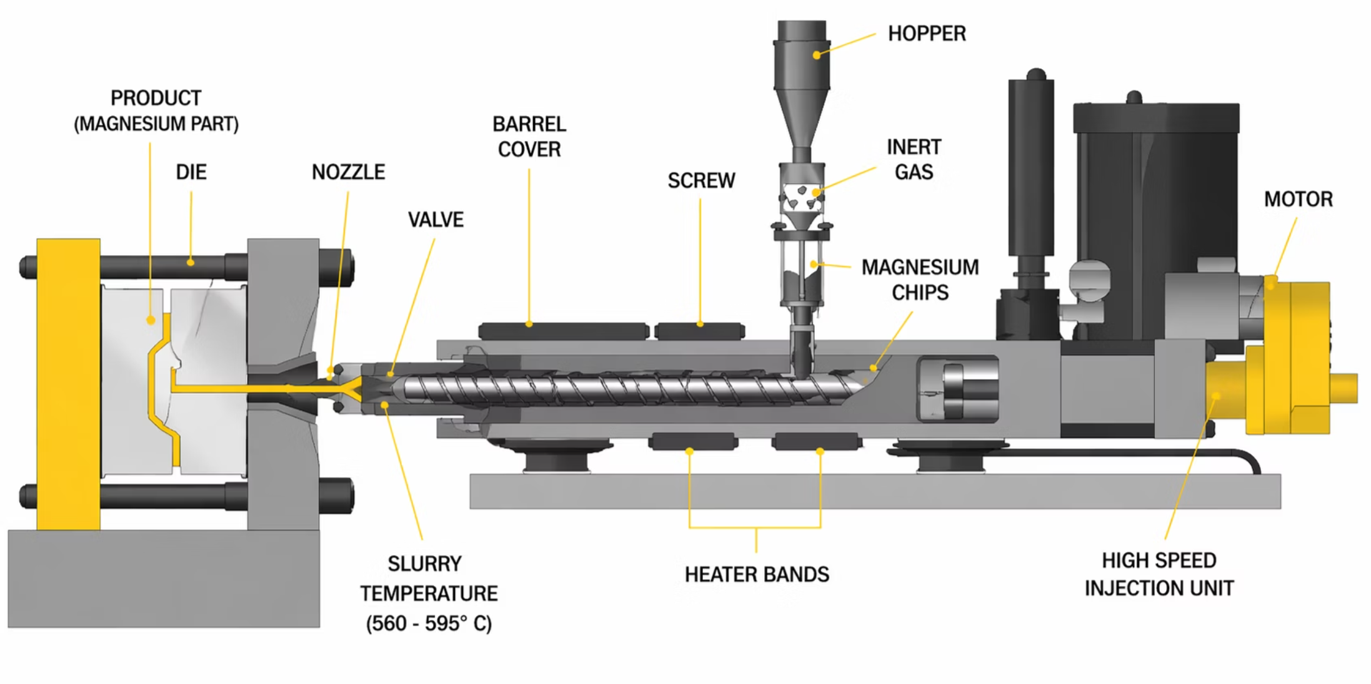
Thixomolding works like plastic injection molding, with magnesium. Alloy chips at room temperature drop from a hopper into a heated barrel. The barrel is kept under argon to reduce oxidation of the chips (NADCA, Product Design for Die Casting, 2015), and a rotating screw carries them forward. External heating takes the chips to 560° to 600° C and the screw’s shearing turns them into a dough-like slurry. The screw then drives the slurry into the closed mold. In our machines, injection including dwell pressure takes about 0.03 seconds and the full cycle about 70 to 90 seconds, depending on component size (Leggera thixomolding page, 2026).
Because the slurry is part solid and more viscous than liquid metal, it fills the mold with less turbulent flow, so less gas is trapped (International Magnesium Association, accessed October 2026), and the part shrinks less as it solidifies. A 2025 review of the process puts thixomolded porosity under 1.5 percent and shrinkage at 0.38 to 0.45 percent, with fewer gas pores, shrinkage defects and surface cracks than high-pressure die casting (Huang, Jiang and Wang, Journal of Magnesium and Alloys, 2025). The die casting industry’s own trade association lists the main advantages of thixomolding as “lower porosity, longer mold life (due to the lower casting temperature), more rapid start-up, change-over and shut down of the process, and reduced melt loss” (NADCA, Product Design for Die Casting, 2015).
See every step with photos on our magnesium thixomolding page.
How the Magnesium Die Casting Process Works
The magnesium die casting process starts in a furnace. Ingot is melted and held as liquid metal under a protective cover gas, because molten magnesium oxidizes readily; sulfur hexafluoride (SF6) “has been shown to be an extremely effective oxidation inhibitor for magnesium alloys” (Luo, Journal of Magnesium and Alloys, 2013). The molten metal is forced through a narrow opening into the mold at a very fast rate, for example 20 m/s, and high pressure is applied while it solidifies (International Magnesium Association, accessed October 2026).
There are two machine types. In hot-chamber die casting the injection system sits in the melt; a typical 400-ton machine makes parts up to 2.5 kg at up to six parts per minute, which makes it very competitive for small parts. In cold-chamber die casting, molten magnesium is ladled or pumped into a shot cylinder for each shot and injected by a plunger at 5 to 10 m/s; this is the process used for large automotive castings such as instrument panel beams, and the entire cycle usually takes around one minute (Luo, Journal of Magnesium and Alloys, 2013).
The trade-offs come from the liquid metal. Injecting it at high speed traps gas, and “the biggest drawback of the conventional high-pressure die casting process” is “the high porosity level due to entrapped gases” (Luo, Journal of Magnesium and Alloys, 2013). About 40 to 60 percent of the metal becomes process scrap via the runner system and overflow (International Magnesium Association, accessed October 2026); it can be reprocessed, but remelting typically adds 5 to 10 percent to material cost (NADCA, Product Design for Die Casting, 2015). And SF6, where die casters still use it, is a potent greenhouse gas: over 100 years it is 23,500 times more effective at trapping heat than the same amount of carbon dioxide (US EPA, updated December 2025). A 2025 review puts die casting’s consumption at about 5 to 8 kg of SF6 per ton of magnesium (Huang, Jiang and Wang, Journal of Magnesium and Alloys, 2025).
The Same Magnesium Casting Alloys for Both
In most cases there is no special thixomolding alloy to qualify. Thixomolders generally run the same magnesium foundry alloys as hot-chamber die casters, AZ91D, AM50 and AM60 (NADCA, Product Design for Die Casting, 2015), and a 2025 review names AZ91D, AM60B and AM50A as the commercial alloys widely used for thixomolding because of their wide semi-solid range (Huang, Jiang and Wang, Journal of Magnesium and Alloys, 2025). So the magnesium casting alloy on your print can usually run in either process. AM60 has been used for a crash-relevant one-piece cross car beam (International Magnesium Association, accessed October 2026).
What changes is how the same alloy performs. Our published material data is for AM60B:
| AM60B | Elongation | Yield | Tensile | Modulus |
|---|---|---|---|---|
| Die cast | 6% | 130 MPa | 220 MPa | 45 GPa |
| Thixomolded | 14.8% | 145 MPa | 280 MPa | 45 GPa |
Source: Leggera Technologies published material data, capabilities page, 2026.
When Die Casting Is the Right Call
Die casting is the more established process, and for many parts it is the right one. Choose it when:
- The part is small and the volume is very high. Hot-chamber machines make small parts at up to six per minute, and a cold-chamber cycle usually takes around one minute (Luo, Journal of Magnesium and Alloys, 2013). Our own thixomolding cycle is about 70 to 90 seconds, depending on component size (Leggera thixomolding page, 2026). A 2025 review puts thixomolding cycles at about 1.25 times as long as hot-chamber die casting and 1.2 times as long as cold-chamber (Huang, Jiang and Wang, Journal of Magnesium and Alloys, 2025).
- Piece price is the only measure. The same review puts the single-piece cost ratio of thixomolding to hot-chamber die casting at about 1:0.85, and to cold-chamber at about 1:0.9 (Huang, Jiang and Wang, Journal of Magnesium and Alloys, 2025); a machine maker’s table gives the same ratios for material cost (Japan Steel Works, a thixomolding machine maker, accessed October 2026). Where porosity, wall thickness and post-processing do not matter to the part, that difference decides it.
- The part is already die cast and validated. A die-cast design does not become a thixomolded design by changing the supplier. The gains come from designing for the process, so moving a part is a redesign, not a one-for-one swap.
- The part is aluminum or zinc. Thixomolding is a semi-solid process for components made only from magnesium alloys (NADCA, Product Design for Die Casting, 2015).
- You need the widest supplier base. Most magnesium applications are made by high-pressure die casting, because it offers high production volume and low production cost (International Magnesium Association, accessed October 2026).
When Thixomolding Wins
Thixomolding earns its place where the part itself is better for it, and where the steps after molding cost more than the seconds on the machine.
- Structural parts with thin walls. Walls down to 0.5 mm (Leggera thixomolding page, 2026) against 1 to 1.5 mm for magnesium die casting (Luo, Journal of Magnesium and Alloys, 2013), and draft as low as 0 (Leggera thixomolding page, 2026). Thinner walls and zero-draft faces mean less metal in the part. Our AM60B data shows 14.8 percent elongation thixomolded against 6 percent die cast (Leggera capabilities page, 2026).
- Housings and electromagnetic and radio frequency interference (EMI-RFI) shielded parts. Thixomolded magnesium offers EMI-RFI shielding and linear tolerances of ±0.001 in. for each inch of dimension (Leggera thixomolding page, 2026). A 2025 review attributes “higher dimensional accuracy” to thixomolding’s lower shrinkage, 0.38 to 0.45 percent, compared with high-pressure die casting (Huang, Jiang and Wang, Journal of Magnesium and Alloys, 2025).
- Parts where porosity is a cost. Every die-cast part that has to be X-rayed, straightened or machined to gage carries that cost. Our process comparison shows thixomolded parts skipping biscuit trimming, X-ray and straightening entirely (Leggera process comparison, 2026).
- Large parts. We run some of the world’s largest thixomolding machines (Leggera homepage, 2026), and we have built a 45,000 sq ft addition to our Holly facility to house our two new 2,500-ton thixomolding machines, which will let us mold much larger parts such as cross car beams (Leggera, 2026). Machine sizes are still growing: a 2025 review reports large-scale thixomolding machines of 3,000 to 4,000 tons launched by Chinese equipment makers (Huang, Jiang and Wang, Journal of Magnesium and Alloys, 2025).
- Long programs. Our molds can last 1,000,000 shots (Leggera homepage, 2026). A 2013 review gives 250,000 to 300,000 shots as typical for a magnesium die-casting die (Luo, Journal of Magnesium and Alloys, 2013), and a 2025 review rates thixomolding mold life longer than both die casting types: 1, against 0.9 for hot chamber and 0.8 for cold chamber (Huang, Jiang and Wang, Journal of Magnesium and Alloys, 2025). Ask us what tool life to plan for on your part.
A real example. On the Jeep Wrangler spare tire carrier, thixomolding was required because of unacceptable tolerances associated with die-cast magnesium. Replacing cast magnesium with thixomolded magnesium increased ductility by 10 percent and saved nearly $15 per vehicle compared to die casting. Read about the Society of Plastics Engineers (SPE) award.
Semi-Solid Cousins: Thixocasting and Rheocasting
Thixomolding is one of a family of semi-solid metal processes. The International Magnesium Association lists thixomolding, rheocasting, thixocasting and thixoforming as forms of semi-solid metal casting, which allows for low porosity levels, complex shapes and longer die life (International Magnesium Association, accessed October 2026). The difference is where the semi-solid metal comes from. Thixocasting reheats pre-cast billet slugs into the semi-solid range before they are cast. Rheocasting, a form of semi solid die casting, makes the semi-solid structure from liquid metal right beside the die casting machine (NADCA, Product Design for Die Casting, 2015). Thixomolding makes the slurry from solid chips inside the machine’s barrel, so there is no melt and no separate billet. Semi-solid castings are also made in aluminum, while thixomolding is used only for magnesium alloys (NADCA, Product Design for Die Casting, 2015).
Thixomolding vs. Die Casting FAQ
Is thixomolding the same as injection molding?
In principle, yes: thixomolding is injection molding for magnesium. The machine looks and works like a plastic injection molding machine, with a hopper, a heated barrel and a screw, but it processes magnesium alloy chips into a semi-solid slurry at 560° to 600° C instead of melting plastic pellets. That is why it is also called magnesium injection molding. Die casting, by contrast, injects fully molten metal.
Is thixomolded magnesium stronger than die-cast magnesium?
For the same alloy, it can be. Our published AM60B data shows 280 MPa tensile and 14.8 percent elongation thixomolded against 220 MPa and 6 percent die cast. Lower porosity is a main reason, according to our data; final strength depends on the part design and wall thickness.
Which is cheaper, thixomolding or die casting?
Per piece, die casting usually is: a 2025 review puts the single-piece cost ratio at about 1:0.85 to 1:0.9 in die casting’s favor. Per finished part the answer depends on what comes after molding. Thinner walls use less metal, and parts that skip X-ray, straightening and heavy machining, on molds that last longer, can cost less delivered. A feasibility review on your print gives the real answer.
Can a die-cast part be switched to thixomolding?
Often, but it should be redesigned rather than copied. The same alloys run in both processes, so material is rarely the problem. The savings come from designing for thixomolding: thinner walls, zero-draft faces and features consolidated into one part.
How is rheocasting different from thixomolding?
Rheocasting makes a semi-solid metal structure from liquid metal next to a die casting machine, then casts it. Thixomolding starts from solid magnesium chips and makes the slurry inside the molding machine’s barrel, so there is no melt furnace.
Bottom line: if the part is small, simple and price-driven, die casting is hard to beat. If it is a thin-wall structural part, a housing or a large part where porosity, post-processing or a feature die casting cannot give drives the cost, put thixomolding on the table and ask for a feasibility review.
Send a part print for a feasibility review
Send us a part print, a 3D model or a die-cast part you want to improve. Our engineers will review it for thixomolding and tell you plainly whether it fits, including when it does not.